
Course Description
“Connecting the physicality of the pressroom to format and collation gave me a great model to think through the discovery process with a new book.” — 2017 student
Via lectures and hands-on workshops, the course covers the identification and description of paper (laid vs. wove, watermarks, sheet sizes); typography (type sizes, fonts, and non-textual material); letterpress composition and printing; illustration processes (relief, intaglio) and their use in hand-press books; binding materials (textile, leather, parchment, paper), methods, and decoration; provenance (markings, inscriptions, bookplates, the ways in which books have been physically altered by their owners); bibliographical description; and the use of physical evidence to address broader questions. Topics include: how to read a bibliographical description of a hand-press-period book (format, collation, signings, pagination); edition, issue, and state; and online resources concerning the physical aspects of pre-1800 books. The course relies heavily on Rare Book School’s rich collection of hand-press books and related artifacts.
In their personal statement, applicants should describe the extent of their background in the history of books and printing, the nature of their interest in the subject, and how they expect to apply what they learn. There is no formal prerequisite for the course, though students with no prior exposure to hand-press books may be directed to other Rare Book School course(s) before being offered admission to G-20.
Note on the differences between the “Printed Books: Description & Analysis” courses (G-20 and G-30) and Introduction to the Principles of Bibliographical Description (G-10)
Introduction to the Principles of Bibliographical Description (G-10) and the “Printed Books” courses (G-20 and G-30) cover similar ground. G-10, however, focuses intensively on format, collation, and the rigorous description of hand- and machine-press period books through description practice and lab sessions; it also emphasizes self-study of physical features and terminology through museum sessions. Its primary text is Fredson Bowers’ Principles of Bibliographical Description, supplemented by Philip Gaskell’s A New Introduction to Bibliography.
In the “Printed Books” courses, Gaskell serves as the principal text. G-20 and G-30 are intended for collectors, booksellers, librarians, educators, and others who seek an introduction to the physical features of printed books—presented in a more traditional, interactive seminar setting—but who do not wish to spend extended time on the study of format and collational formulas. Students in all three courses enjoy extended contact with Rare Book School’s renowned study collections of books, bindings, and related artifacts.
If you anticipate the need to prepare your own bibliographical descriptions, including accurate collational formulas, you may find G-10 more suited to your needs. If a broader overview, combined with the ability to interpret bibliographical descriptions, would better suit your professional or personal interests, then either of the “Printed Books” courses would be a good fit. Because of the overlap in course content, Rare Book School discourages students from applying to a “Printed Books” course and G-10 in the same year; however, students who complete either of the “Printed Books” courses are welcome to apply to G-10 in subsequent years, but not vice versa. Students who take G-10 will find themselves well prepared for the Advanced Descriptive Bibliography course (G-50).
Faculty
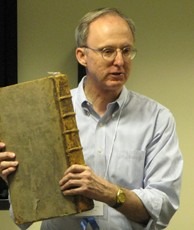
David R. Whitesell
David R. Whitesell retired as Curator in the Albert and Shirley Small Special Collections Library at the University of Virginia in 2022. He previously worked as Curator of Books at …
Advance Reading List
Preliminary Advices
Students will get far more out of the course if the advance reading is done carefully and completely. As you go through the reading, jot down what you would like to have explained, or see examples of, in class. Among other topics, the course will cover the basics of descriptive bibliography (format, collational formula, and description of paper, typography, and binding), though with more emphasis on understanding descriptions found in bibliographies and catalogs than on writing one’s own.
Required Reading
- Gaskell, Philip. A New Introduction to Bibliography. New York & Oxford: Oxford University Press, 1972, corrected 2nd printing, 1974; paperback edition, New Castle, DE: Oak Knoll Press, 1995. Use any printing except the 1st, uncorrected printing (1972). This is the primary text for the course, so please bring it to class if possible. Please read pp. 1-185 (“Book Production: The Hand-Press Period 1500-1800”), 313–35, and 368–80. Gaskell can be a dense first-time read, so you may wish to read the assigned sections through quickly, then re-read those describing type, paper, printing procedures, and anything else of interest. Don’t let yourself get bogged down in minutiae, as we will review much of Gaskell in class. Although G-20 does not cover the machine-press period (pp. 189–310), you may find it helpful to skim this portion if you have time.
- Pearson, David. Provenance Research in Book History: A Handbook. [New and revised edition] Oxford: Bodleian Library, 2019. Despite its Anglocentric focus, this is a very useful introduction to marks of provenance and their identification, with excellent color images. Please read pp. 1–92, 107–73, and 343–78; browse the rest to the extent of your interest. If you only have access to the first edition (1994 or 1998 printing), read pp. 1–26, 38–70, 82–139, and 274–96.
- Pearson, David. English Bookbinding Styles 1450-1800. London: The British Library; New Castle, DE: Oak Knoll Press, 2005; corrected 2nd printing 2014.
- Another useful introduction to a complex and amorphous subject. The text and illustrations (many in color) provide an excellent expansion of Gaskell’s limited coverage, albeit only partly applicable to binding styles elsewhere in Europe. Please read pp. x–xi, 1–40, and browse pp. 41–163.
Required Viewing
- The Making of a Renaissance Book. 1969. 22 minutes. Available on YouTube.
- An excellent visualization of the punchcutting, typefounding, typesetting, and printing processes described in Gaskell.
- The Anatomy of a Book: I. Format in the Hand-Press Period. 1991. 30 minutes. Available on YouTube.
- Two weeks prior to the course, students will receive a link to a 40-minute RBS Bookbinding Demonstration Video, which we ask you to view.
Recommending Reading
- Bowers, Fredson. Principles of Bibliographical Description. Princeton, NJ: Princeton University Press, 1949; several reprint editions; paperback edition, with introduction by G. Thomas Tanselle, New Castle, DE: Oak Knoll Press, 1994. Anyone with a serious interest in bibliography and book history should tackle this magisterial but challenging work at some point. If you have time, please read Appendix I, then Chapters 5 (skipping over the finer print) and 7 (pp. 193–254, 269–84, 457–62; see also Gaskell, pp. 328–35 for a concise—but not fully accurate—summary of these chapters.) The basic concepts elucidated by Bowers will be covered in class. Then read (or re-read) Bowers after taking this course, by which time his discussion should make considerably more sense.
- Carter, John. ABC for Book Collectors. London: Hart-Davis, 1952. 9th edition, revised by Nicolas Barker & Simran Thadani, New Castle, DE: Oak Knoll Press, 2016. Use any later edition. A downloadable PDF of the 8th edition (2004) is available free of charge. An elegant and witty guide to essential terminology, well worth reading. Some terms pertain to post-1800 imprints or are rarely used nowadays, but it is useful nonetheless to know these.
Final Note
If possible, bring a copy of Gaskell with you; it is not necessary to bring copies of Bowers, the Pearson books, or Carter. At RBS, students will receive the full course workbook; note pads and pencils will also be provided (feel free to bring your own). There is no need to bring a laptop unless you wish to. RBS classrooms tend to be rather aggressively air conditioned, so a sweater may be useful. An optional description workshop will be held early Thursday evening.
Course Evaluations
Course History
-
2021
David R. Whitesell teaches this course online (22 hours).
-
2010–
David R. Whitesell teaches this course in person (30+ hours) as “Printed Books to 1800: Description & Analysis.”
-
2008–2009
David R. Whitesell teaches this course as “Bibliographer’s Toolkit: Printed Books to 1800.”