
Course Description
This online course will introduce students to the use of publishers’ and book trade archives and other records for the study of the creation, production, distribution, and reception of American books produced from the colonial period to the twentieth century. The focus will be on American material, though British practice may also be addressed by way of comparison. Particular attention will be paid to financial records and how to decipher those that reflect the ways that publishers and other book trade members adapted standard business and accounting practices, including double-entry bookkeeping, to their needs.
The course is chiefly aimed at scholars who are engaged in book historical research, but will also be of use to librarians, collectors, and others whose duties or interests require an understanding and knowledge of the archives and records that document the history of American book publishing. To benefit fully from the course, participants should already have a basic understanding of publishing practices and the book trades.
In their personal statements, applicants are requested to briefly state their interest in the field, current research projects, and topics or issues that they would particularly like the course to address. Over the course of the month, students will be expected to work in pairs on two course-related exercises as homework outside regular class time.
Students are also required to submit a resumé or C.V. which includes a list of prior completed RBS courses.
Faculty
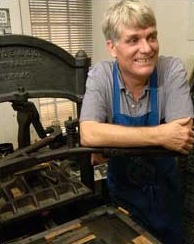
Michael Winship
Michael Winship is Iris Howard Regents Professor of English II (emeritus) at the University of Texas at Austin and edited the final three volumes of the nine-volume Bibliography of American …
Advance Reading List
Required Reading
No single book or study can serve as a specific guide to the study of publishers’ archives, but students will find that a solid understanding of publishing and book trade practices is indispensable for understanding these records. To that end, students would do well to familiarize themselves with the five-volume A History of the Book in America series:
Hall, David D., ed. A History of the Book in America. Chapel Hill, University of North Carolina Press, 2000–2010. Five volumes.
I would suggest that participants pay particular attention to the various chapters in each volume that address manufacturing, distribution, and the book trade, especially for the period that addresses their particular research interests.
My survey essay, although written long ago, is still useful:
Winship, Michael. “Publishing in America: Needs and Opportunities for Research.” In Needs and Opportunities in the History of the Book: America, 1639-1876, edited by David D. Hall & John B. Hench, 61–102. Worcester, MA: American Antiquarian Society, 1987. Available online at: http://www.americanantiquarian.org/proceedings/44539374.pdf
The literature, both academic and popular, on the social and cultural implications of bookkeeping, accounting, and the nature of business records in history is vast and varied, and you may wish to browse the library shelves for things that seem of interest. Here are three articles that I have found useful in thinking about these matters:
McGaw, Judith A. “Accounting for Innovation: Technological Change and Business Practice in the Berkshire County Paper Industry.” Technology and Culture 26 (October 1985): 703–25.
Zakim, Michael. “Bookkeeping as Ideology: Capitalist Knowledge in Nineteenth-Century America.” Common-Place 6 (April 2006), http://common-place.org/book/bookkeeping-as-ideology/.
Kafka, Ben. “Paperwork: The State of the Discipline.” Book History 12 (2009): 340–53.
Supplemental Reading
The business records of the Boston publishers Ticknor and Fields are one of the richest survivals from the nineteenth century, and we will be using them repeatedly throughout the week. In preparation, students will benefit from perusing the following:
Tryon, Warren S. and William Charvat, eds. The Cost Books of Ticknor and Fields. New York: Bibliographical Society of America, 1949. Read “Introduction,” pp. xiii–l.
Winship, Michael. American Literary Publishing in the Nineteenth Century: The Business of Ticknor and Fields. Cambridge UP, 1995; paperback edition 2002. Read “The Business Records of Ticknor and Fields,” pp. 24–38, and “Distribution and Ticknor and Fields,” pp. 148–69.
Bonus:
The following articles by the British novelist John Lanchester are not immediately relevant to this course, but they do provide an interesting and useful summary of the history of money, banking, and the development of bitcoin:
“When Bitcoin Grows Up,” London Review of Books (21 April 2016); available online: http://www.lrb.co.uk/v38/n08/john-lanchester/when-bitcoin-grows-up
“The Invention of Money,” The New Yorker (29 July 2019); available online: https://www.newyorker.com/magazine/2019/08/05/the-invention-of-money
Course History
-
2021
Michael Winship teaches this course online (22 hours).
-
2015–2019
Michael Winship teaches this course in person.