
Course Description
Taking a broadly chronological approach, the development of botanical illustration is traced from medieval manuscript and early printed herbals, through florilegia and scientific plant illustration in the seventeenth century, to the floras and monographs of the eighteenth and nineteenth centuries, with firsthand examination of some of the most spectacular color-plate books produced in any field.
Central to this course is an emphasis on the printing history of botanical books and the ways in which print-making processes affect the style and content of printed images. The Library’s rich collection of field sketches, finished drawings, and printing proofs reveal the multiple processes that shaped botanical image making. Students will learn to identify key picture-printing technologies—woodcut, intaglio, wood-engraving, lithography, and photomechanical processes—and the ways in which each technology, and the different artists and makers involved, impacted the aesthetic and scientific content of the images.
Illustrations in botanical books were critical to multiple and overlapping fields of knowledge in a globalized world. They facilitated the adoption of new pharmaceuticals within traditional materia medica; they introduced ornamental exotics to gardeners and florists, and they promoted economically useful plants that fueled imperialist goals. At the same time, botanical illustrations were fundamental to the development of the botanical sciences of classification, anatomy, morphology, physiology, and ecology. Yet illustrated botanical books were products of the artistic and visual culture of their times, and constrained by the economics of printing, publishing, and marketing. Students will discover firsthand how these interdependent themes coexist in the materiality of the printed book.
The contributions of women are of particular importance in the creation of botanical illustration as well as its consumption. Paying attention to the participation of women redresses the imbalances in the historical narrative and requires us to analyze the books studied not in terms of singular authors and illustrators but as the products of multiple agents, both acknowledged and hidden. Women’s roles in metropolitan and colonial settings as well as the contributions of Indigenous artists to European books are explored. Students will also view examples of East Asian botanical art and book production, contrasting with the European books that are the focus of the collection and the course.
The spaces and collections at Oak Spring Garden Library lend themselves to a fully integrated teaching experience combining slide presentations, demonstrations, and student exercises together with close examination of drawings, printing plates and blocks, and printed books. The library contains original drawings by many of the leading botanical artists from the sixteenth century to the present day and some of the finest copies of the great herbals, florilegia, and botanical atlases.
The distinguished botanical illustrator Alice Tangerini will lead a drawing session to provide students with practical experience.
*This is a fully residential course, a unique opportunity to stay on the Oak Spring Garden site, explore the gardens and grounds, work in the beautifully furnished private library built for Rachel “Bunny” Mellon, and learn from fellow students and the internationally acclaimed instructors. There are two fees associated with this course: tuition ($1,185), and housing and food ($950). Owing to the lack of other nearby accommodations and the nature of the arrangements with this private institution, both fees are required to participate in this course. The latter covers the cost of staying in on-site accommodations of well-appointed single rooms with en suite baths, and of dining at Oak Spring. Three meals and refreshment breaks each day are included in the cost. Scholarship and fellowship tuition waivers cover the cost of tuition; these tuition waivers do not extend to include the $950 fee for housing and food.
The course will be of interest to academics (at the Ph.D. candidate level and above), independent scholars, botanical artists, curators, and collectors. There are no specific entry requirements, but in their personal statements, applicants should describe their background knowledge in areas covered by the course. Students are required to upload a copy of their most recent CV along with their personal statement.
Faculty

Peter Crane
Sir Peter Crane, FRS is President of the Oak Spring Garden Foundation in Virginia, an estate of Rachel Lambert Mellon that includes an exquisite garden, as well as an exceptional …
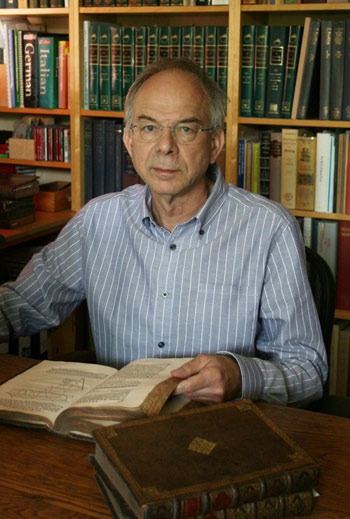
Roger Gaskell
Roger Gaskell is a retired antiquarian bookseller specializing in scientific medical and technical books, and has worked closely with academic libraries in the U.K. and the U.S. He has taught …
Advance Reading List
Required Readings
Read as much as you can of:
Note: These two books are complimentary, Blunt and Stern emphasizing the art, Harris the science of botanical illustration. Blunt and Stern provide a wide-ranging survey of the great botanical artists and their works covering the whole period we will be studying; Harris is topical, looking at the importance of published illustration to the development of different areas of plant science, often using less well-known examples.
Blunt, Wilfred, and William T. Stearn. The Art of Botanical Illustration. London: Royal Botanical Gardens Kew; New York: ACC Art Books, 2021.
and
Harris, Stephen A. The Beauty of the Flower. The Science and Art of Botanical Illustration. London: Reaktion Books Ltd., 2023.
Familiarize yourself with the main image-making processes in one or more of the following:
Bridson, Gavin D. R. Printmaking in the Service of Botany. Pittsburgh, PA: Hunt Institute for Botanical Documentation, 1986. Out of print, downloadable PDF: https://www.huntbotanical.org/publications/show.php?126. Secondhand copies readily available at around $30 and recommended as resolution is lost in the PDF.
Griffiths, Antony. Prints and Printmaking : An Introduction to the History and Techniques. London: British Museum Publications, 1980.
Twyman, Michael. The British Library Guide to Printing: History and Techniques. Second impression, First published 1998 by The British Library. Toronto: University of Toronto Press, 1999.
Further Readings
A few suggestions for browsing and background reading, which you might like to do before the class.
Tomasi, Lucia Tongiorgi. An Oak Spring Flora. 1997; Tomasi, Lucia and Tony Willis. An Oak Spring Herbaria, 2009; Raphael, Sandra. An Oak Spring Sylva, 1989; and Raphael, Sandra. An Oak Spring Pomona, 1990. https://issuu.com/osgf
Tyrell, Katherine. “The Top Botanical Art Compendium.” Botanical Art & Artists, 2015. https://www.botanicalartandartists.com/.
Morton, A. G. History of Botanical Science: An Account of the Development of Botany from Ancient Times to the Present Day. London: Academic Press, 1981.
Bleichmar, Daniela.Visible Empire: Botanical Expeditions and Visual Culture in the Hispanic Enlightenment. Chicago: University of Chicago Press, 2012.
Blunt, Wilfrid, and Sandra Raphael. The Illustrated Herbal. Rev. ed. London: Frances Lincoln, 1994.
Bynum, Helen, and William Bynum. Botanical Sketchbooks. Princeton Architectural Press, 2017.
Endersby, Jim. Imperial Nature: Joseph Hooker and the Practices of Victorian Science. Chicago: University of Chicago Press, 2008.
Fry, Carolyn, and Emma Wayland. The Botanists’ Library : The Most Important Botanical Books in History. Brighton: Ivy Press, 2024.
Kusukawa, Sachiko. Picturing the Book of Nature. Image, Text, and Argument in Sixteenth-Century Human Anatomy and Medical Botany. Chicago: University of Chicago Press, 2012.
McBurney, Henrietta. Illuminating Natural History. The Art and Science of Mark Catesby. London: Paul Mellon Centre for Studies in British Art, 2021.
Nickelsen, Kärin. Draughtsmen, Botanists and Nature: The Construction of Eighteenth-Century Botanical Illustrations. Archimedes (Dordrecht, Netherlands) 15. Dordrecht: Springer, 2006.
Rix, Martyn. Indian Botanical Art: An Illustrated History. London: Kew Publishing, 2021.
Shteir, Ann B. Cultivating Women, Cultivating Science: Flora’s Daughters and Botany in England, 1760 to 1860. Baltimore: Johns Hopkins University Press, 1996.
Flannery, Maura C. In the Herbarium. The Hidden World of Collecting and Preserving Plants. New Haven and London: Yale University Press, 2023.
Course Evaluations
Course History
-
2023–
Sir Peter Crane and Roger Gaskell co-teach this course. They are joined by guest lecturers.
-
2022
Sir Peter Crane, Roger Gaskell, and Amy Meyers co-teach this course. They are joined by guest lecturers Lara Call Gastinger and Megan McNamee.