
-
Dates5 June–30 December 2000
-
LocationUniversity of Virginia Rotunda
-
Curated ByCalvin P. Otto
Gold rushes, 1624-1897
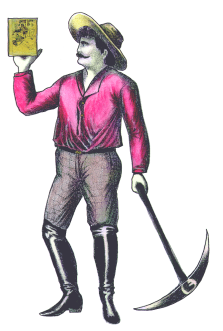
Virginia was in the grip of gold fever in 1624. Capt. Smith complained that the rage was all to ‘dig gold, wash gold, refine gold, load gold, such a bruit of gold that one mad fellow desired to be buried in the sands lest they should by their art make gold of his bones.’ Gold fever of another kind gripped 19th-century book publishers. Some of their elaborate gold-stamped cloth bindings form the centerpiece of this exhibition. Gold fever returns to Virginia with the Eureka! exhibition.
The exhibition begins with the story of gold and its physical characteristics. Perfectly malleable and ductile, gold can be beaten into leaf 0.00014 mm thick, historically used in gold-tooled book-bindings, and developed in the 19th-century for gold-stamped bindings on cloth.
1830s
Gold-stamping came into use as a practical way of labeling books bound in cloth. Publishers were quick to exploit the appeal of gold, for they realized that a cloth binding so embellished would have a greater permanence in the eye of the public. Gold-stamped spines began to be common on clothbound books in the later 1830s, emulating the spine labels of leatherbound books. Spines received special attention because of their visibility to potential customers.
1840s
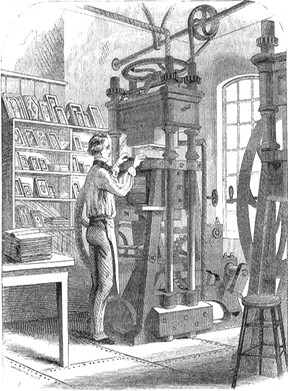
In November 1848, with the discovery of gold in California, the New York Herald-Tribune declared that the United States was ‘on the brink of an Age of Gold.’ By 1851, the yield of the Californian gold was running at about 175,000 lb. a year, largely from placer mining. The exhibition includes the gold scales used by a Boston minister who got rich assaying Stamping a book cover, from Harper’s Story Books (New York 1855). gold in 1849 California, as well as a cross-section of a gold-bearing stream to show where alluvial gold is normally found.The ‘Age of Gold’ produced gold gift bindings offered by publishers as ‘cloth, gilt,’ or ‘cloth, extra gilt.’ The dieengravers created gold-stamped cloth bindings of great exuberance and quality, using both designs imported from England and their own more robust (if sometimes more naive) American creations (Cases 4L through 5L).
1850s
This golden age, in which pure gold leaf was used on a rich variety of book covers (Cases 6R through 7R) continued well into the 1850s. The great recession of 1857 was to bring about a changeover to less expensive substitutes for gold, substitutes which were sought for almost as eagerly as the real thing. The recession was caused by the failure of railroad bonds, and exacerbated by the loss of a single gold shipment, worth $1,500,000, caused by the sinking of the SS Central America in a great storm off North Carolina.
1860-1880s
After the 1850s, although there were still elaborate designs, use of gold stamping declined. Gold stamping was only one of a number of options open to publishers seeking to market their books. The purity of mid19th century designs was abandoned. New techniques for color printing on book cloth, and competition at the cheaper end of the market from popular fiction bound in luridly-printed boards, brought about a final decline in the use of gold on book covers (Cases 8L through 9L).
1890s
By the 1890s, where gold leaf does appear, as on the cover for the Library of Universal Knowledge (1893), it is often found in combination with a range of other techniques — blind stamping, stamping in silver foil as well as gold foil, and color printing (Cases 9R through 10L). Otherwise, the gold stamping may replicate a line block used on the title page, as in Lewis Carroll’s The Hunting of the Snark (1898). There were many gold rushes in 19th-century America. The most significant was the California Gold Rush (Cases 5R and 6L). Placer mining S the ’49-ers’ method of panning gold directly from the stream bed S has frequently been described. Less glamorous (and much harder work) was the hard-rock mining of Cripple Creek (Case 9R) in the 1895-1910 period. The Klondike Alaska/Yukon Gold Rush of 1897 re-fired the public imagination: even if you couldn’t get there yourself, you could buy a can of ‘Gold from Alaskan Rivers’ containing placer gold ore and instructions on panning (Case 11L). And if few of the men and women who flocked to Dawson City from all over the world had much leisure to read, their own stories would appear, all over the English-speaking world, in adventure books (Case 10L) stamped, most likely, in gold leaf or foil.
Gold stamping today
Within two decades even this modest survival, on the covers of children’s books, was to be unusual. By the 1920s focus had shifted towards book jacket design. The only sign of innovation, short-lived, was in the relatively unusual area of art nouveau-influenced publishers’ bindings in the 1890s, where swirling designs in gold make a refreshingly subtle contrast with the cream of the vellum board (Case 10L). Gold sells books. Gold stamping, mainly using foil, is now as likely to be found on paper or plastic, as on cloth: on the front cover of a paperback book, or even on a dust-wrapper or a ring-binder. Gold (or even yellowish) ink still suggests opulence. It also appears, invariably, on the covers of almost all the literature of gold and gold mining (Case 12R). Gold stamping is still popular as a means of decorating the printed book. It is used for its association with the traditional well-dressed library of bibliophile editions, for instance in the Franklin Library’s edition of Ralph Ellison, Invisible Man (1980). All that glisters is not gold: Franklin Library may use 23 carat, but most of the gold leaf used today in gold-stamping is a cheap gold foil such as Dutch (German) gold, the brass-gold alloy used as a substitute for gold leaf since the late 19th-century. The items in this exhibition of gold and books are from the collection of its curator, Calvin P. Otto.