
-
Exhibition DatesMay through November 2026
-
LocationHosted by Rare Book School on the second floor of UVA’s Shannon Library
-
Curated ByBarbara Heritage & Zoe Langer
-
SponsorThe Pine Tree Foundation of New York
Color. Shape. Movement. Craft. Poetry survives not just as streams of words, but also as material artifacts that have lives and stories of their own. Forms and words are richly entangled, inseparably expressive. This exhibition highlights the tangible artifacts that make poetry palpable. From metal to silk—parchment to paper pulp—calligraphy to typography—this show is a feast for the senses.
“Ut pictura poesis” / “As is painting, so is poetry”
– Horace, Ars poetica
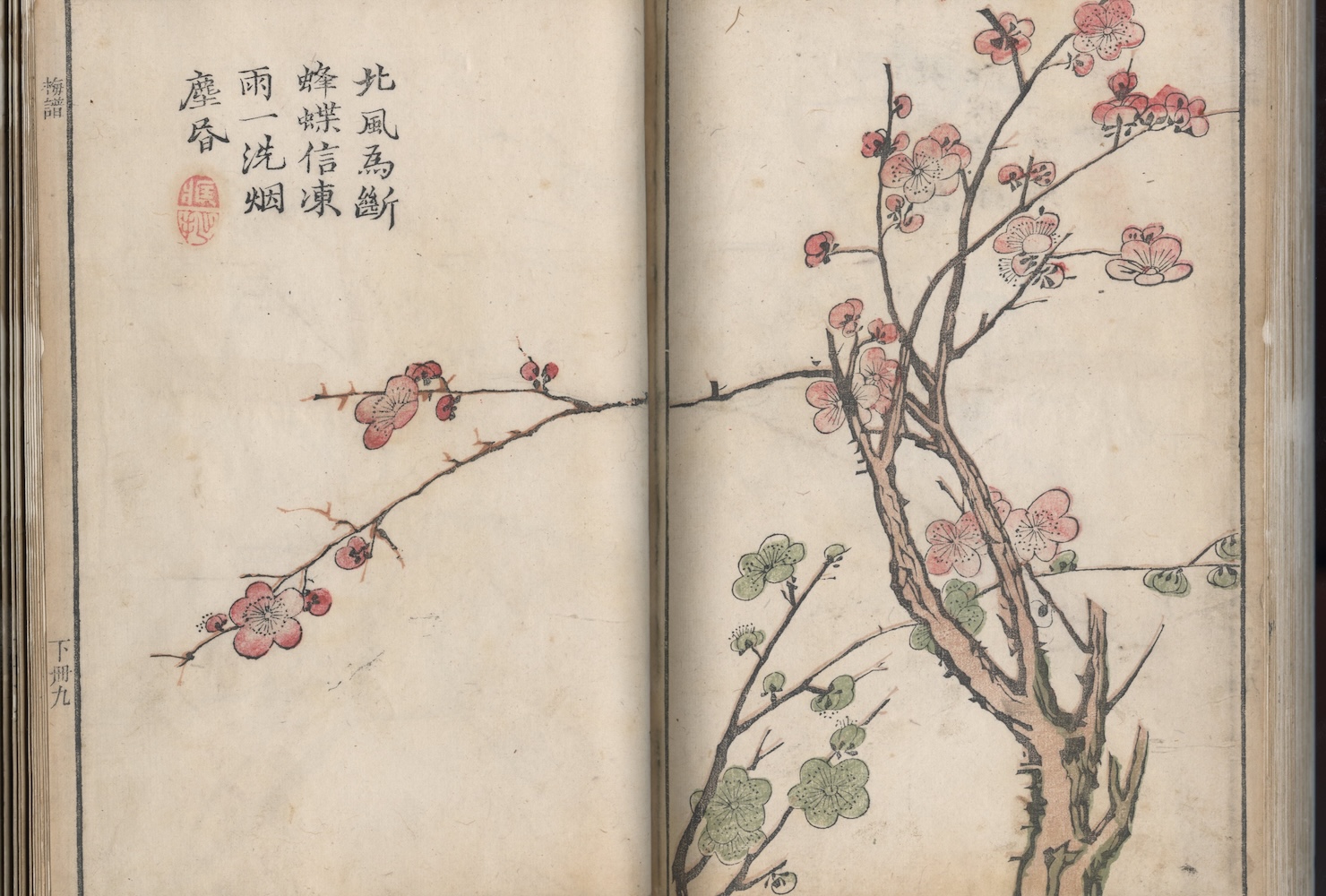
We begin by reflecting on poetry as it converges with other genres and media. Poetry has historically intersected with botany in the form of florilegia, as well as with painting and landscape. Throughout the show, you will find examples of these overlapping interests, including copies of the Mustard Seed Garden Manual (Chinese: 芥子園畫傳, Jieziyuan huazhuan) from Rare Book School’s Guanhailou Collection, donated by Xia Wei and Soren Edgren. The manual, compiled and produced during the early Qing Dynasty, incorporates calligraphy and poetry into its lessons on painting, showing just how closely these arts overlapped and cross informed one another. As both a complement and counterpoint to this narrative, we show Turner’s Illustrations to Sir Walter Scott’s Poetical Works (1852)—a volume of 24 illustrations depicting images from Scott’s poems, but lacking any of his verses. In this case, the object stands in for Scott’s iconic writing, which was so popular and well known at the time, it was already, in a sense, “present.” The middle of the gallery features objects related to sound, where we show convergences among poetry, oral recitations, songs, and lyrics.
Craft, Material, Letterform, Image, Color, Scale, Form
Poiesis (Greek: ποίησις) is an act of making. Poets are no strangers to the craft of writing. But few of them are deeply familiar with the craft of the book—William Blake being perhaps the most notable example, among other artists featured in this show: Dante Gabrielle Rossetti, William Morris, Vasily Kamensky, Walter Hamady, Barbara Henry, Johanna Drucker, Clarissa Sligh, Margaret Randall, and Mayra Sablón. Other poets exhibited here have closely collaborated with craftspeople tied to book arts—including (but not limited to) Thomas Hardy, Paul Laurence Dunbar, Gwendolyn Brooks, Edwidge Danticat, and Monica Ong.
We also explore the work of the craftspeople who make poetry present in the world of manuscript and print, and who, for so many readers, remain hidden in plain sight: papermakers, scribes, calligraphers, block cutters, engravers, etchers, designers, illustrators, colorists, printers, publishers, editors, and bookbinders—and even censors and mutilators of books. We feature a binding and the tools used to craft it by one such maker: Anne De LaTour Hopper, a bookbinder trained in France who immigrated to the United States.
Movement, Intervention, Communities, Splendor, Transformation
We read, and we feel—we may even turn a wheel. Poetry moves. It is made possible by political and artistic movements. It also innovates. It migrates across printings into new editions, anthologies, and collections. It is adapted and absorbed into other projects. Poetry is made by communities, and it makes community—it effects interventions and is sometimes affected by interventions. Objects call attention to these mutable, shifting dynamics—especially in multiples.
We celebrate the beauty and artistry of these books—the ability for books to convey a sense of awe or wonder through their material forms. Stamped with gold, bound in shining silk, flecked with paint, adorned with color. Splendor communicates in ways that words alone cannot express.
Finally, poetry has the power to elevate and transform, and books are essential for that transformation to take shape. Enduring over centuries, they carry the past into the present, making visible former histories and potential futures, and leading to new visions and ways of seeing the world we share.
Related Events
Objects of Poetry Closing Reception, Writer’s Eye Reading & Remarks by Special Guest Caroline Willis
Join Rare Book School on 30 October for special events hosted in conjunction with our Objects of Poetry exhibition, on view through 13 November on the second floor of UVA’s Shannon …
Remix: A Found Poetry & Printing Workshop with Barbara Henry
Join Rare Book School and renowned printer and book artist Barbara Henry for a two-day workshop, free and open to UVA students, faculty, and members of the local community. Inspired …
Learn More
For additional information about the exhibition and related programming, please contact curators Barbara Heritage and Zoe Langer.