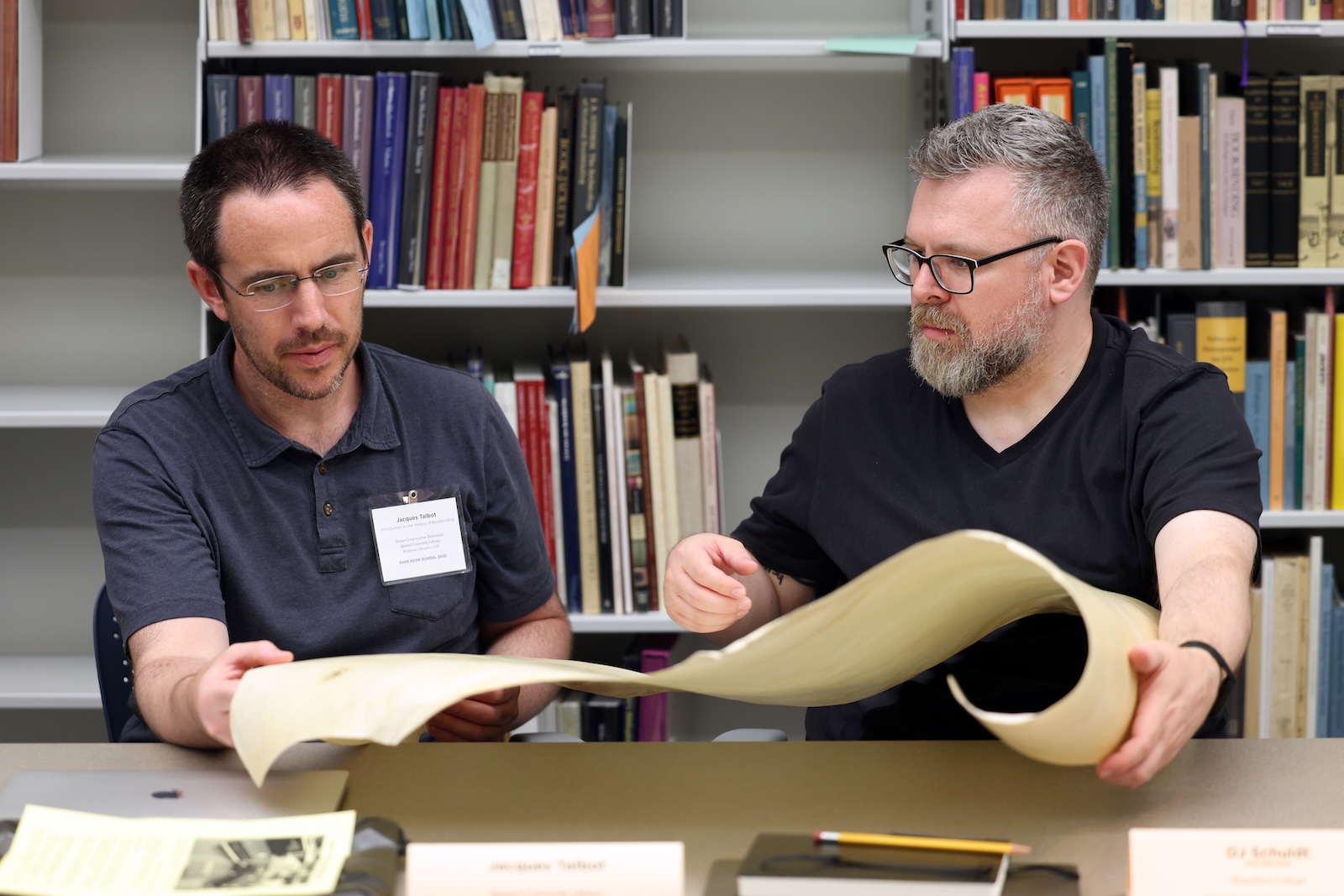
In college and graduate school, Jacques Talbot (pictured above, at left) studied fine art and the history of art, design, and visual culture in the UK and Canada. Summers, however, found him in a canoe, enforcing fishing permits and campground regulations, or leading public outreach programs on human-wildlife conflict prevention. At first glance, his work as a River Ranger in Wyoming seems at odds with Talbot’s later roles in the world of art and rare books, where he worked as a Salesroom Assistant for Christie’s in London and as an Art Preparator for a gallery in Ontario. Yet whether educating campers about “leave no trace” recreational activities or assessing safe ways to handle rare materials, conservation has always been a central theme of Talbot’s career.
Today Talbot is Senior Conservation Technician for Queen’s University Archives and W.D. Jordan Rare Books and Special Collections in Ontario. In this role, he is responsible for caring for rare books, special collections, manuscripts, literary and business papers, regional archives, university records, and photographs, among other materials and ephemera. Talbot helps the Conservator manage activities in two Conservation Laboratory locations, coordinating safe handling and storage for, and conservation documentation of, the University’s unique and rare collections. “My bibliographical interests are many and varied,” Talbot says, “though a specific recent highlight has been playing a key role in a print stewardship project related to the gothic fantasy and science fiction collection titles in Queen’s University Library.”
Talbot originally learned about Rare Book School from a colleague, who spoke “reverentially” about RBS. While Talbot admits that it was difficult to choose just one course from the School’s many summer offerings, he eventually settled on B-10: Introduction to the History of Bookbinding, taught by Karen Limper-Herz. He enrolled in 2025, receiving RBS’s Directors’ Scholarship to support his attendance. The course, Talbot says, “has changed how I engage with and interact with our rare books and special collections on a fundamental level.”
Talbot points to how Limper-Herz wove together the visible aspects of rare books—their cover decoration, for instance—with the hidden elements, from binding structures to a book’s cultural context, that are only revealed upon closer examination. He also notes that RBS brings together people with a wide range of bibliographical perspectives. “I consider the shared experience of attending RBS with my classmates, and the discussions that occurred among us during and in between classes,” he says, “to be a vital contributing factor towards the inherent value of my RBS experience.” The RBS staff, he adds, further contributed to a welcoming learning environment.
Overall, Introduction to the History of Bookbinding gave Talbot “an entirely new lens and visual vocabulary through which to engage with our collection” at Queen’s University. “It is knowing where to look, what to look for, and the significance of certain observations,” he says, “that allow me to become acquainted with individual titles in our collection in a way that was unavailable to me previous to attending RBS. I can say with confidence that my time at RBS has been my most formative professional development experience to date.”
And while Talbot has found his own approach to conservation enriched by his RBS experience, he also is bringing that knowledge to his colleagues at Queen’s University. Building on what he learned at RBS, Talbot and his colleagues now can more thoughtfully and effectively conserve the materials entrusted to their care.
Photo above of Jacques Talbot and DJ Schuldt in B10 Introduction to the History of Bookbinding, 2025. Credit: Andrew Shurtleff, LLC.