
Course Description
This course will introduce students to the manufacturing methods, publishing practices, distribution networks, and use of books, periodicals, and other printed materials in the United States during the industrial era, roughly from the 1820s to the 1940s. Particular attention will be paid to exploring the introduction and impact of the new industrial production technologies that defined the period, but other topics to be addressed include: the development of trade publishing and other publishing systems; methods of book distribution, including the role of bookstores, as the book market expanded across the continent; authorship, copyright, and the importance of the international trade in American and British books and texts both before and after the 1891 Chace Act; and reading and the multiple ways that readers acquired and used books.The course is aimed at scholars, librarians, collectors, and others whose work or research requires in-depth knowledge of the American industrial book and, thus, is intended for those who already have some familiarity with book production methods and American book history. Although it serves as a chronological sequel to James N. Green’s “History of the Book in America, c. 1700-1830” (H-70) and his and my “History of the Book in Antebellum America” (H-135), the approach here is more bibliographical, in the broadest sense, than book historical.
The Rare Book School teaching collection is especially rich in printed materials from this period, and students will have an opportunity to study multiple examples that illustrate important features of the American industrial book; digital copies of some manuscript material will also be discussed to illustrate the business practices of book manufacturers and publishers. Students will be introduced to important reference works and other resources for the study of American book history and are encouraged to share their own research projects with the instructor and class members. In their personal statement, applicants are requested to summarize briefly their background in the field, current research projects, if any, and topics or issues that they would particularly wish the course to address.
Faculty
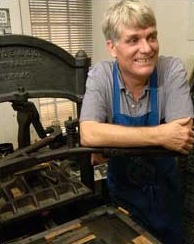
Michael Winship
Michael Winship is Iris Howard Regents Professor of English II (emeritus) at the University of Texas at Austin and edited the final three volumes of the nine-volume Bibliography of American …
Advance Reading List
Required Readings
Casper, Scott A., Jeffrey D. Groves, Stephen W. Nissenbaum, and Michael Winship, eds. A History of the Book in America, Volume 3: The Industrial Book, 1840-1880. Chapel Hill: University of North Carolina Press, 2007. Especially the introduction and coda (by Scott Casper) and chapters 1 and 4 (by Michael Winship & Jeff Groves), and chapter 8 (by Barbara Sicherman).
Kaestle, Carl F. and Janice A. Radway, eds. A History of the Book in America, Volume 4: Print in Motion, The Expansion of Publishing and Reading in the United States, 1880-1940. Chapel Hill: University of North Carolina Press, 2009. Especially the prologue, epilogue, and introductions (by Carl Kaestle & Jan Radway), chapter 3 (by Michael Winship), chapter 4 (by Jim West), and chapter 5 (Peter Jaszi & Martha Woodmansee).
A History of the Book in America is the standard modern scholarly history of the book in America, and students are encouraged to consult these and the other volumes in the series for further browsing and selective additional reading.
Suggested Readings
Lehmann-Haupt, Hellmut. The Book in America: A History of the Making and Selling of Books in the United States, rev. ed. New York: Bowker, 1951. Parts II-III (pp. 63-419). Still a useful overview after nearly 70 years. You may wish to skim or pass over parts that seem too detailed or tedious.
For additional historical background, one or more of the following may also be useful:
Charvat, William. Literary Publishing in America, 1790–1850. Philadelphia: University of Pennsylvania Press, 1959; reprinted Amherst MA: University of Massachusetts Press, 1993.
Sheehan, Donald. This Was Publishing: A Chronicle of the Book Trade in the Gilded Age. Bloomington: Indiana University Press, 1952.
West, James L. W., III. American Authors and the Literary Marketplace since 1900. Philadelphia: University of Pennsylvania Press, 1988.
Two of the best “house” histories, describing the development of two major American publishing firms:
Ellen B. Ballou. The Building of the House: Houghton Mifflin’s Formative Years. Boston: Houghton Mifflin, 1970.
Eugene Exman. The House of Harper: One Hundred and Fifty Years of Publishing. New York: Harper & Row, 1967. See also Exman’s The Brothers Harper (1965).
For bibliographical practice, the following are the fundamental texts:
Gaskell, Philip. A New Introduction to Bibliography. Oxford: Oxford University Press, 1972; corrected reprint 1974, frequently reprinted by Oak Knoll Press. Read pp. 189–310.
Bowers, Fredson. Principles of Bibliographical Description. Princeton: Princeton University Press, 1949; reprinted New Castle DE: Oak Knoll Press, 1994. Read pp. 355–453.
Course Evaluations
Course History
- 1997–
Michael Winship teaches this course, as “The American Book in the Industrial Era, 1820–1940.”
- 1995–1996
Michael Winship teaches this course, as “The American Book in the Industrial Era, 1820–1914.”
- 1994
Michael Winship teaches this course, as “The Book in the Industrial Era, 1820–1914.”