
Course Description
This 10-hour online course is intended for persons who desire a better understanding of the physical examination and description of printed books, especially of the period 1550–1850. It is designed both for those with little formal exposure to this subject and for those with some general knowledge who seek a systematic discussion of (or refresher to) the elements of physical description as set forth in Fredson Bowers’ Principles of Bibliographical Description. This abbreviated course differs from G-10 in that it focuses more narrowly on the creation of a basic bibliographical description, or formulary: a statement consisting of a book’s format and collational formula (a condensed description of the gatherings comprising a book and the order in which they are intended to be bound, the number of leaves per gathering, and the manner in which the gatherings are signed and the leaves paginated). Other topics to be touched upon include ideal copy, edition, issue, and state, the limitations of descriptive bibliography, and its application to broader research questions. Because this course lacks a formal laboratory component, students who complete the course will be comfortable reading complex bibliographical descriptions but will likely need further training before being able to produce accurate bibliographical descriptions on their own. During the course week, however, students are encouraged to practice describing several pre-1850 books they may have access to. Each student may schedule an online tutorial with an instructor to review their draft descriptions and resolve basic questions of procedure, evidence, and description. These optional online tutorials are likely to be scheduled during the week following the course. In their personal statement, applicants should describe the extent of their background in bibliography, the nature of their interest in the subject, and how they expect to apply what they learn. There is no formal prerequisite for the course, though students with little prior exposure to pre-1850 books may be directed to other Rare Book School course(s). Students who have some prior background in bibliography or who have taken either G-10 or G-20, but seek a comprehensive refresher in bibliographical fundamentals, are encouraged to apply. Click here to view the course description for the in-person version of this course, “Introduction to the Principles of Bibliographical Description.”Faculty
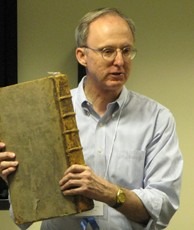
David R. Whitesell
David R. Whitesell retired as Curator in the Albert and Shirley Small Special Collections Library at the University of Virginia in 2022. He previously worked as Curator of Books at …
Advance Reading List
Required Reading
The following two works are the foundational texts for this course and provide the background necessary for understanding what the formulary describes. Please have a copy of Bowers on hand during class.
Gaskell, Philip. A New Introduction to Bibliography. Oxford: Oxford University Press, 1972; corrected ed. 1974; several subsequent reprintings with minor corrections; paperback ed. published in 1995 for $39.95 by Oak Knoll Press.
Gaskell describes the processes that produce the books we set ourselves to describe, and some parts of Bowers are virtually incomprehensible without some knowledge of these processes. One possible strategy would be to read all of Gaskell through quickly, then return to the more technical sections, especially those describing type, paper, and printing procedures of the hand-press period.
Bowers, Fredson. Principles of Bibliographical Description. Princeton, 1949; reprinted 1994 (with an introduction by G. Thomas Tanselle) by Oak Knoll Press for $39.95.
Begin by reading the foreword, chapter 1, and Tanselle’s introduction (if you have the Oak Knoll edition). Then go right on to chapters 5, 7 (pp. 269-284), and 12 (pp. 427-438), which cover the basics of the formulary. See also the “Digest of the Formulary” (pp. 457–462). At first encounter they may prove hard to understand. Don’t despair: we will cover the key aspects in class, but you MUST read these chapters ahead of time in order to benefit fully from the course. Once you have an actual book in hand to describe, things become much clearer, so please try to have several pre-1850 books available to practice with during (or immediately after) the course week. If you have time, read as much of the rest of the book as you can, especially pp. 113–123, 255–268, and 285-311. Gaskell offers a concise explanation of format and collation (pp. 321–335), though he deviates from Bowers at several points.
Required Viewing
The Anatomy of a Book: I. Format in the Hand-Press Period. Written by Terry Belanger and directed by Peter Herdrich. 1991. 30 minutes. Available on YouTube.
The Making of a Renaissance Book. 1969. 22 minutes. Available on YouTube. An excellent visualization of the hand-press period punchcutting, typefounding, and printing processes described in Gaskell.
Admitted students may request a set of facsimile practice materials from RBS by emailing rbsprograms@virginia.edu. Please note: The workbook will be made available online, and the facsimile practice materials are not a required component of this course. Students who do wish to request these materials should be advised that orders placed fewer than two weeks in advance of the course may not arrive prior to the course.
If you can, it would be helpful to review the workbook and practice with the facsimile sheets, bringing any questions you have to class.
Recommended Reading
Belanger, Terry. “Descriptive bibliography.” In Book Collecting: A Modern Guide, edited by Jean Peters, pp. 97–115. New York: R. R. Bowker Company, 1977.
This article provides a useful overview of the field and its practice. (The excerpt available on the website of the Bibliographical Society of America omits the part of the essay that is immediately relevant to this course.)
Carter, John. ABC for Book Collectors. London: Hart-Davis, 1952. 9th edition, revised by Nicolas Barker and Simran Thadani. New Castle, DE: Oak Knoll Press, 2016.
The 8th edition (2004) is available free of charge as a PDF. An elegant and witty guide to essential terminology. Use any later edition.
Final Note
Here is a sample basic bibliographical description of the sort recommended by Bowers:
Feijoó y Montenegro, Benito Gerónimo. Theatro crítico universal. Nueva impresion. Volume IV. Madrid: Imprenta Real, 1773.
4°: a-b8 c4 A-2G8 [$4(-c3,4) signed]; 260 leaves, pp. [I-II] III-XL, 1-478 [479-480] [misprinting 155 as 551, 176 as 276, 272 as 172, and 394 as 294]
Click here for more sample bibliographical descriptions.
Course Evaluations
Course History
- 2021
David Whitesell teaches this 10-hour online version of the course.
- 2012–
David Whitesell teaches this course in person as “Introduction to the Principles of Bibliographical Description.”