
Course Description
N.B. Enrollment for this course is limited to participants in the RBS-Mellon Library and Archives Conservation Education (LACE) Consortium Program.
The course is intended for book conservators who seek a richer understanding of the physical features of printed books, especially of the period 1500–1900, and of standard bibliographical methods for describing those features. The course will cover typography (type sizes, fonts, and non-textual material); letterpress composition and printing; paper and illustration as bibliographical evidence; provenance (ownership markings, inscriptions, bookplates, and the ways in which books have been physically altered by owners and readers); and the analysis and description of book structure (format, collation, signing, pagination; edition, issue, and state). It will also offer a look at the uses of bibliographical evidence and some key printed and online resources. Students will gain a rich and multi-faceted appreciation for the “archaeology” of books, that is, for books as physical objects, for the layers of evidence of ownership and readership that books acquire over time, and for bibliographical approaches to the study of books. Students will also improve their skills in describing books prior to treatment, in identifying features worthy of preservation, and in interpreting bibliographical sources, enabling them to work more effectively with curators, researchers, collectors, and booksellers.
This intensive course consists of lecture; closely supervised laboratory sessions in which students practice the determination of format and collation, the writing of standard bibliographical descriptions, and the description of provenance evidence; and hands-on museum sessions in which students examine materials drawn from the renowned Rare Book School collections. In addition, students will devote each evening to homework assignments.
The course is open to practicing book and paper conservators, and to those enrolled in book and paper conservation programs. In their personal statement, applicants should describe the extent of their background in the history of books and printing, and how they expect to apply what they learn.
Note on the differences between “Physical Bibliography for Book Conservators” and Introduction to the Principles of Bibliographical Description (G-10)
This course covers much of the same ground as Introduction to the Principles of Bibliographical Description (G-10), but with somewhat more time devoted to lecture, and somewhat less time to homework, lab sessions, and museums. G-40 introduces some aspects of the Printed Books: Description & Analysis courses (G-20 and G-30), in particular an introduction to provenance. Paper, illustration processes, and bookbinding are treated only in terms of their bibliographical applications. Students who take G-40 will find themselves well prepared for the Advanced Descriptive Bibliography (G-50) course.
Faculty
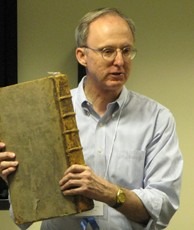
David R. Whitesell
David R. Whitesell retired as Curator in the Albert and Shirley Small Special Collections Library at the University of Virginia in 2022. He previously worked as Curator of Books at …
Advance Reading List
Preliminary Advices
Students will get far more out of the course if the advance reading is done carefully and completely. It is especially important that students review the assigned portions of Bowers prior to class.
Required Reading
The following two books are the foundational texts for this course. Please buy or borrow copies of both Gaskell and Bowers and bring them with you to class.
Gaskell, Philip. A New Introduction to Bibliography. New York & Oxford: Oxford University Press, 1972, corrected 2nd printing, 1974; paperback edition, New Castle, DE: Oak Knoll Press, 1995.Use any printing except the 1st, uncorrected printing (1972). Please read pp. 1–335, but don’t get bogged down in the more technical sections.
Bowers, Fredson. Principles of Bibliographical Description. Princeton, NJ: Princeton University Press, 1949; several reprint editions; paperback edition, with introduction by G. Thomas Tanselle, New Castle, DE: Oak Knoll Press, 1994. Anyone with a serious interest in bibliography and the history of books and printing should tackle this magisterial, but challenging work at some point. Begin by reading the foreword, chapter 1, and Tanselle’s introduction (if you have the Oak Knoll edition). Then move on to chapters 5, 7 (pp. 269–289), and 12 (pp. 429–438) and Appendix I. (Gaskell offers a concise explanation of format and collation on pp. 321–335, though he deviates from Bowers at several points.) Read as much of the rest of the book as you can, especially pp. 113–123, and pp. 255–268. Then re-read Bowers after taking this course, by which time his discussion should make considerably more sense.
Required Viewing
The Anatomy of a Book: I. Format in the Hand-Press Period. Written by Terry Belanger and directed by Peter Herdrich. 1991. 30 minutes. Available on YouTube.
The Making of a Renaissance Book. 1969. 22 minutes. Available on YouTube.
Both films are also available on a single DVD. You can purchase a copy of the DVD along with a workbook and facsimile practice materials from RBS for $45 (or purchase just the facsimile sheets and workbook for $35). Please note: students located outside of the United States must contact RBS for international shipping rates before sending payment.
Please watch both films before coming to class. For the first, be sure to review the workbook and practice with the facsimile sheets, bringing any questions you have to class. The Making of a Renaissance Book is an excellent visualization of the punchcutting, typefounding, and printing processes described in Gaskell.
Recommended Reading
Carter, John. ABC for Book Collectors. London: Hart-Davis, 1952. 9th edition, revised by Nicolas Barker and Simran Thadani. New Castle, DE: Oak Knoll Press, 2016. The 8th edition (2004) is available free of charge as a PDF. An elegant and witty guide to essential terminology. Use any later edition. Some of the terms are rarely used nowadays, but it is useful nonetheless to know these.
Pearson, David. Provenance Research in Book History: A Handbook. [New and rev. ed.] Oxford: Bodleian Library, 2019. Despite its heavily Anglocentric focus, this is a very useful introduction to marks of provenance and their identification, with excellent color images. Please read pp. 1-92, 107-173, and 343-378; skim the rest to the extent of your interest. If you have access only to the first edition (1994 or 1998 printing), read pp. 1-26, 38-70, 82-139, and 274-296.
Course Evaluations
Course History
-
2019–
David Whitesell teaches this course.