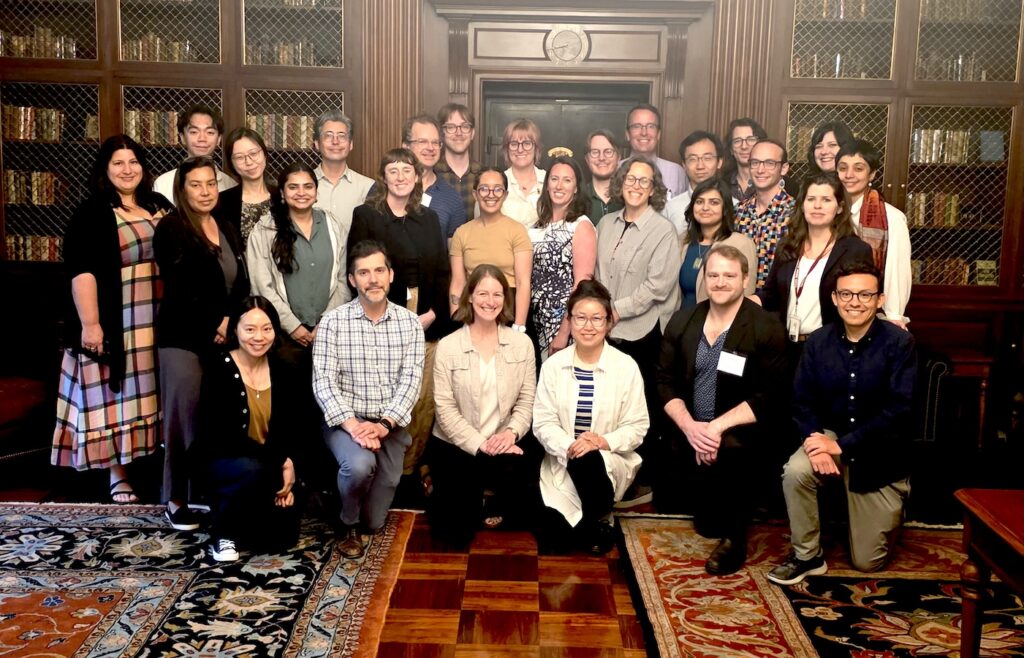
This fall, Rare Book School (RBS) invited writers to spend time with our exhibition Objects of Poetry and respond with poems of their own composition. We’re delighted to announce the three winners of the Writer’s Eye Poetry Contest: Nolan Li, Kayla Duncan, and Nathan Lee, all undergraduate students at the University of Virginia. The winners were invited to read their work aloud at the School’s Objects of Poetry exhibition closing event on 30 October, where they also received RBS-themed prizes.
Rare Book School’s poetry contest was inspired by the Fralin Museum of Art at UVA‘s longstanding “Writer’s Eye” program. Objects of Poetry is curated by RBS’s Barbara Heritage and Zoe Langer, with support from the Pine Tree Foundation of New York. The exhibition is on view through Friday, 20 November 2026 on the second floor of UVA’s Shannon Library.
Congratulations to our winners, and thank you to everyone who submitted a poem! Below, you can read all three winning poems in full.
The Winning Poems
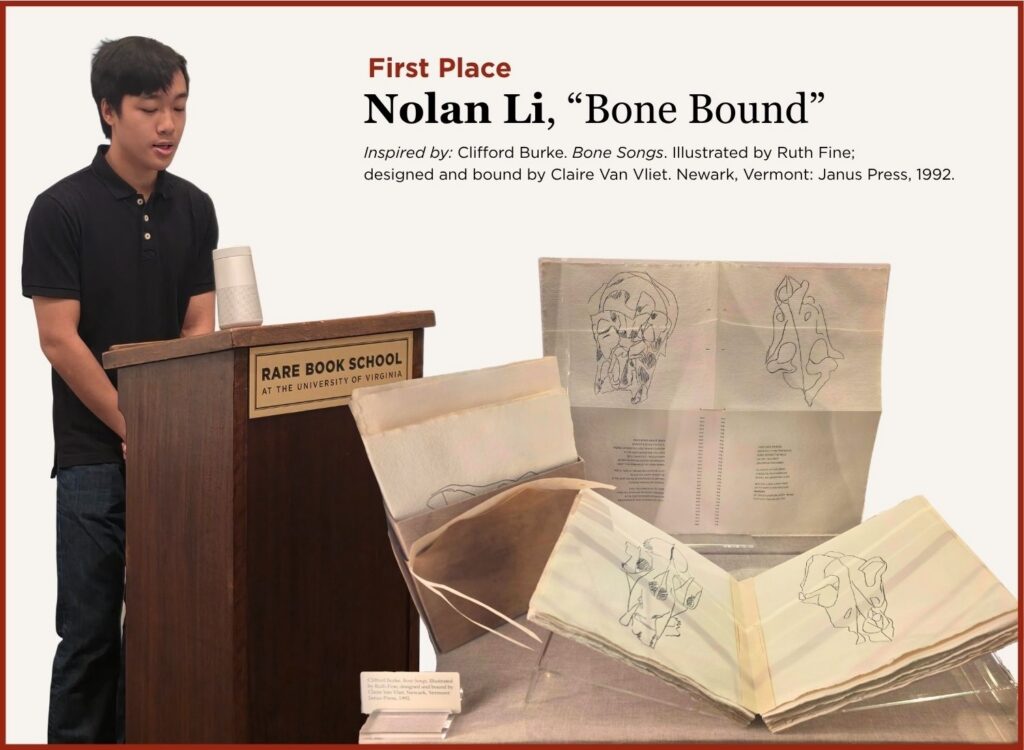
First Place: Nolan Li, “Bone Bound”
Inspired by: Clifford Burke. Bone Songs. Illustrated by Ruth Fine; designed and bound by Claire Van Vliet. Newark, Vermont: Janus Press, 1992.
Bone Bound
bound to this book,
Bones
binding this body
by which a botched suture
sings silently
slipping as it seals this Skull,
binding these bones
back to this body
Back to this book
Determined to be un
bound
***
Nolan Li is a second-year UVA biology major from Alexandria, Virginia, with a particular interest in genetics and health disparities.
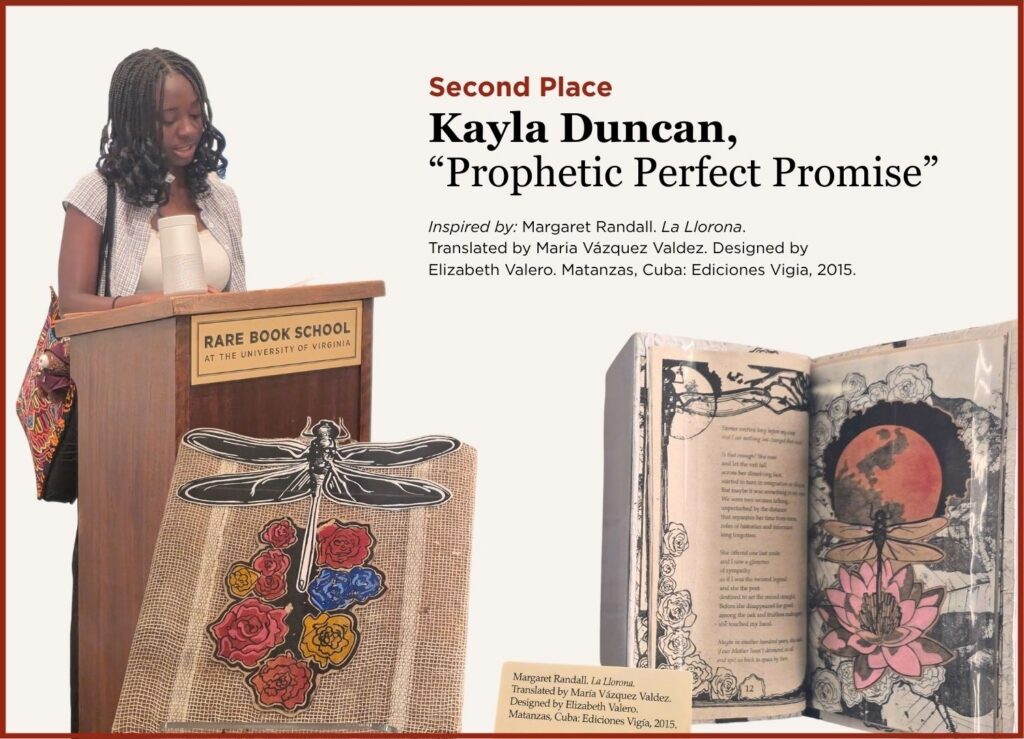
Second Place: Kayla Duncan, “Prophetic Perfect Promise”
Inspired by: Margaret Randall. La Llorona. Translated by Maria Vázquez Valdez. Designed by Elizabeth Valero. Matanzas, Cuba: Ediciones Vigia, 2015.
Prophetic Perfect Promise
Tonight, under our red dusk, tía says:
La libélula es el depredador
más poderoso.
Tomorrow, I translated the sentence: The dragonfly is the most powerful
predator. Shimmering blue under our red sky, the dragonfly lunged at her prey.
She missed.
Mañana, discutimos la falibilidad de la traslación. Tomorrow, we argued about
translation’s fallibility. We tossed it back and forth. Ours. Mine. Yours.
Mine. Yours.
During a different tomorrow, while nightfall’s starry teeth pursued the fleeing
sun, the dragonfly soared, sapphire and angelic. Her descent from the sky
was perfect.
That same tomorrow, she materialized as a bullet. So fast it burned blue.
So fast—it was a dragon. Fantastical beast. She pierced the prey dead
on impact.
After every tomorrow, I disregarded the date. It’s always changing, anyway.
Nightfall widened her maw, so the sun ran faster. We argued about our
translation…ours?
Tonight, tía says: La libélula es el depredador más
poderoso. Sometimes, she promises: I became a dragonfly,
one day.
A SPECIAL NOTE ABOUT THIS POEM’S TITLE:
“Prophetic perfect tense” describes the Old Testament’s usage of past-tense verb conjugations to refer to future events to show that these events were certain/divinely promised. However, there is controversy about how accurate the term is due to the fact that Hebrew’s tenses do not deal with time the same way English does.
***
Kayla Duncan is a first-year student in UVA’s College of Arts & Sciences, planning on majoring in English. She is from Long Island and enjoys writing about identity, nature, and culture.
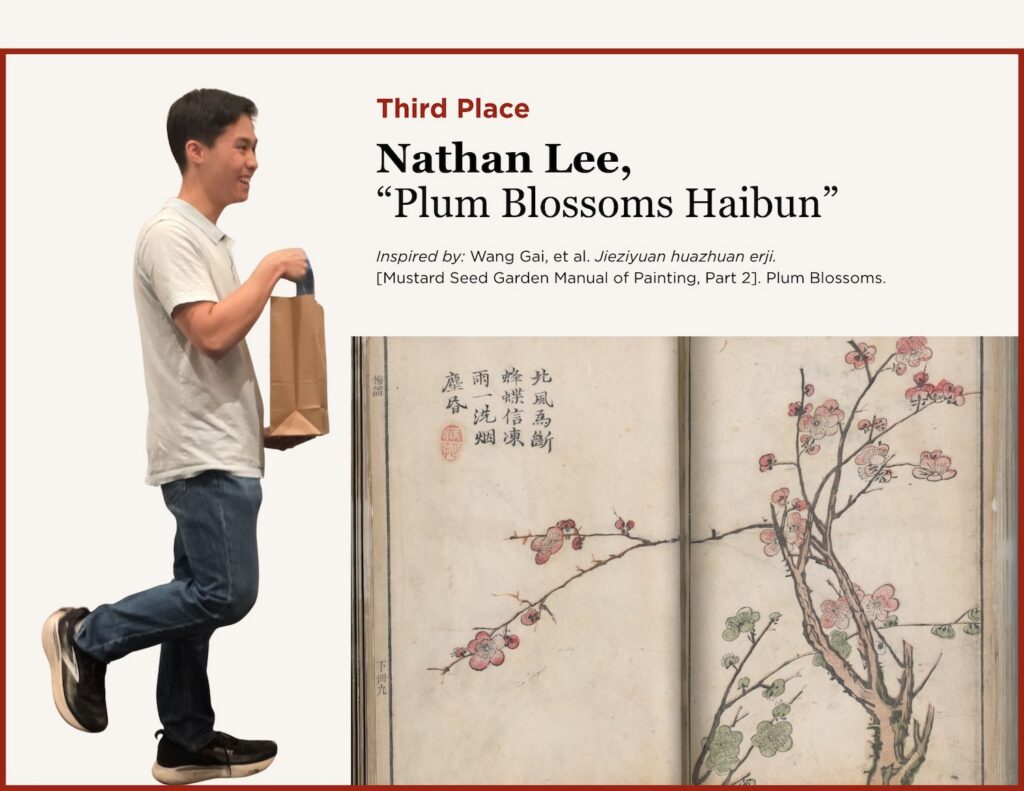
Third Place: Nathan Lee, “Plum Blossoms Haibun”
Inspired by: Wang Gai, et al. Jieziyuan huazhuan erji. [Mustard Seed Garden Manual of Painting, Part 2]. Plum Blossoms.
Plum Blossoms Haibun
October. I stop before a book holding its place in spring. A plum branch reaches across the fold; I follow it until my own reflection interrupts the ink. The paper has yellowed around the flowers. Leaning closer, I look for a fallen petal, then remember where I am.
Outside the window,
one leaf catches on my sleeve.
I carry it home.
***
Nathan Lee is a second-year neuroscience student at UVA, pursuing a career in medicine, with a particular interest in emerging technologies for understanding the brain. Beyond academics, he enjoys graphic design, music, and exploring other creative outlets.