
by Francesca Mancino
Is it a fearful fervor, a wistful nostalgia, or some third complex feeling that makes us anxious about the book becoming increasingly less faithful to its tactile origins? Concern about the book’s future is a tale nearly as old as the physical object itself. Perhaps rather than worrying if they will disappear altogether, we should focus instead on how the book-as-object will be reconsidered as it continues to take new forms in the digital age. What happens, for instance, when an e-book or audiobook strips the material fingerprints that authors, readers, and publishers have left behind? The preservation of physical texts, which are instilled with their own bibliographical data, remains overlooked yet is vital to keeping the book, in all its forms, alive.
Rare Book School (RBS) at the University of Virginia (UVA) provides more than one remedy to conserve the book’s rapidly evolving and complex history. Established in 1983 by MacArthur Fellow Terry Belanger, RBS’s journey began at Columbia University. The school relocated in 1992 and now is housed within UVA’s Edgar Shannon Library. The library recently benefited from an elegant $160 million investment in renovations. This transformation has allowed RBS to settle permanently in one of the library’s most trafficked spaces, where the school has its own suite of classrooms, a typesetting and printing office, and an extensive exhibition hall.
Just this past year, RBS received its largest donation to-date from bibliophiles Cathy and Glen Miranker. Their $3.1 million gift endowed staff member Barbara Heritage’s position as the Miranker Family Director of Collections, Exhibitions & Scholarly Initiatives. Given that Mr. Miranker was part of the team that developed the iMac at Apple, this contribution conveys the couple’s faith that the book-as-object won’t totally surrender itself to the digital. When I visited in June, the exhibition hall displayed the Game of Authors, a card game dating back to 1861; much like “Go Fish,” the rules call for matching authorial cards together. Heritage and Zoe Langer, the joint curators of the Game of Authors exhibition, held a tour and pointed out which then-popular writers have or haven’t planted their flag in the literary canon. Various copies of Dante’s, George Eliot’s, and Charles Dickens’ works were displayed alongside those of lesser-known figures like Robert Southey and Edward Bulwer-Lytton.
RBS offered more than 40 courses in Summer 2025. Along with the in-person courses at UVA and a number of online offerings, other partner institutions, such as Yale, the University of Pennsylvania, and the University of Michigan, also opened their doors to host classes. This year also saw RBS’s first international courses at Oxford University’s Bodleian Library. Each in-person class runs for just five days but offers 30 hours of in-depth instruction by world-renowned experts in their fields. Students can focus their studies by selecting from almost any bibliographical subject, both broad and niche, which can be seen in just a snippet of the summer’s course listings: Medieval Manuscript Fragments: Cataloging and Discoverability; The Printing Press in Spanish America, 1500–1830; Introduction to Audiovisual Archives Management; Material Foundations of Map History, 1450–1900; and Censorship from the Inquisition to the Present. Admission is competitive, making for a highly motivated and engaged community of attendees.
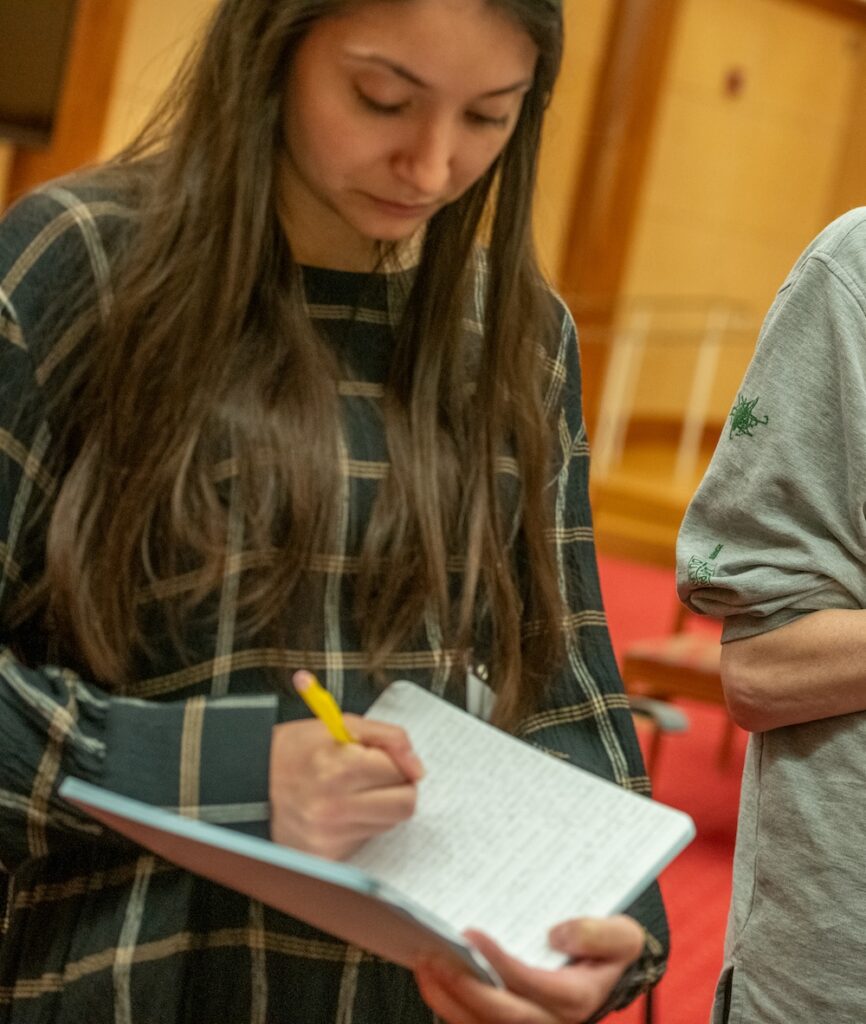
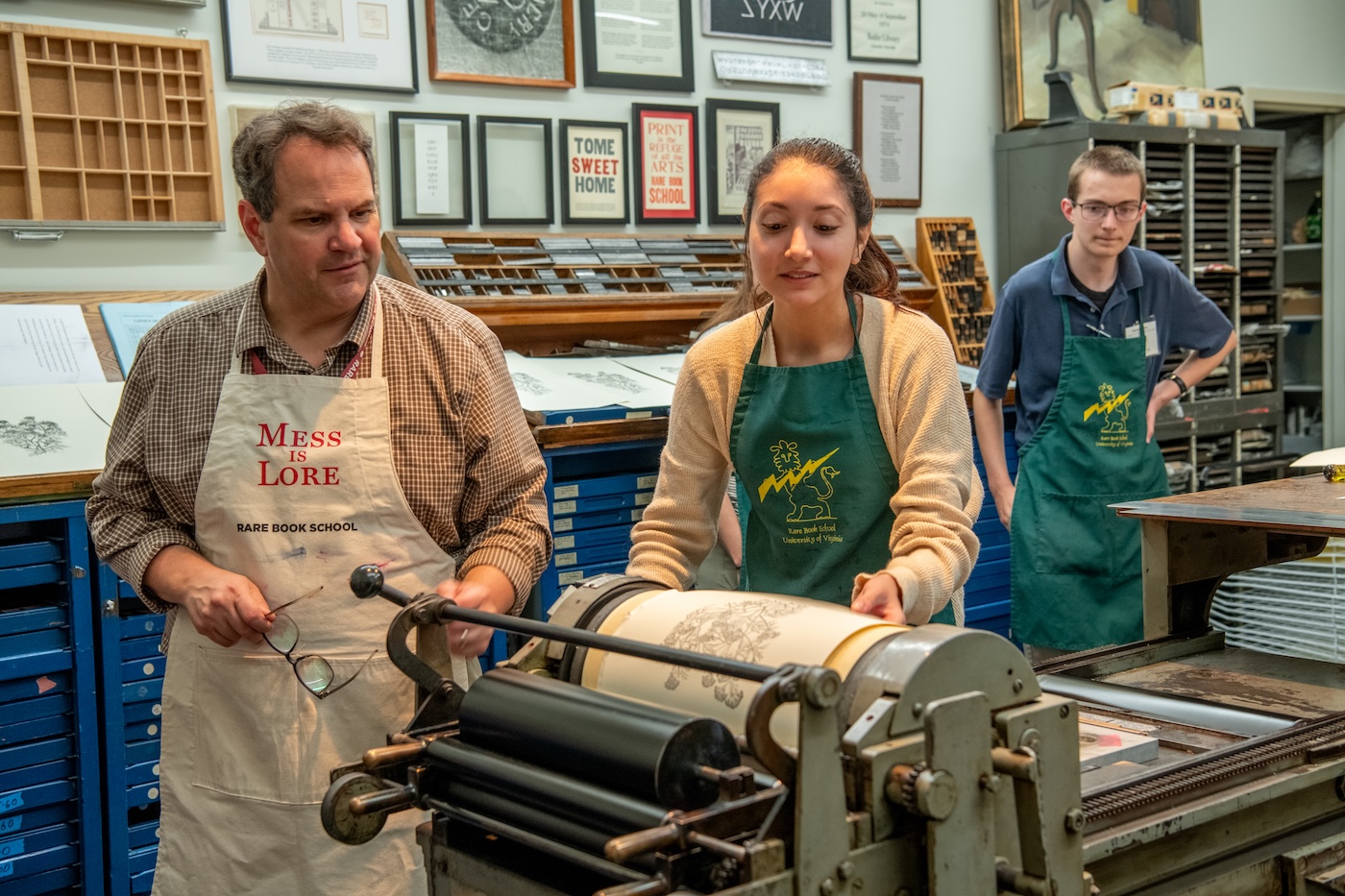
While students can only register for one course per week of classes, I was offered a bibliographical sampler, and this gave me a savory taste of Nick Wilding’s class on Forgeries, Facsimiles & Sophisticated Copies; Yuzhou Bai’s and Soren Edgren’s The History of the Book in China; Eric Holzenberg’s The Printed Book in the West since 1800; and others. When I accepted my invitation to visit RBS from June 8 to 13, I assumed much of the 30 hours of instruction would be spent passively sitting in a classroom. Instead, alongside students, I donned an apron to set the type of a poem and maneuver a printing press, perused an extensive collection of Jane Eyre materials as Barbara Heritage chronicled the many afterlives of Charlotte Brontë’s 1847 novel, and attended former RBS fellow Alexander Bevilacqua’s evening talk on the sixteenth- and seventeenth-century chivalric scrolls that anticipated twentieth-century motion pictures. RBS’s students have represented all 50 U.S. states, including the District of Columbia, and nearly 30 countries, including Argentina, Australia, Brazil, China, Israel, India, Japan, Pakistan, and Ukraine. I encountered many studious “book-gluttons,” as the bibliographer Thomas Frognall Dibdin called them, who are working to bring their knowledge back to their own institutions. Among these were art museum curators; professors and Ph.D. students from English, history, and art history departments; law school professors and librarians; librarians from the Library of Congress and the Harvard-Yenching Library; and rare book dealers. The list of backgrounds ran as long as the ancient scrolls that co-instructors Yuzhou Bai and Soren Edgren passed around their book history and China classroom.
Part of what made each class so remarkable was the peculiarly perfect fit between the instructor and course subject. What better person to teach forgeries and facsimiles than Nick Wilding, a history professor at Georgia State University, who forensically proved a copy of Galileo’s Sidereus Nuncius was not, in fact, the astronomer’s personal one? Wilding’s course covered topics as diverse as how eighteenth- and nineteenth-century forgers deceptively made “a book look like a book” to how printers used crushed beetles to produce scarlet pigments. Wilding also explained how some facsimile book artists intentionally chose not to cover their tracks: purposefully leaving behind footprints of faulty reproduction was a potential way to bequeath a traceable mark onto the text, kind of like a cheeky artistic signature. Further, outside of class, he explained to me that oftentimes forgeries of literary content tend to be poorly done, so glaring indications of forgery tend to be easily perceptible to a trained eye. Maybe this is why rare book forgeries don’t have the same glamorous reputation as art forgeries: artworks require ersatz canvases and paints with convincing brushstrokes, while a novel demands the more tedious task of replicating bindings, typefaces, inks, papers, covers, and, sometimes, handwriting.
David Whitesell’s class, Printed Books to 1800: Description and Analysis, also spotlighted imperfect books. Whereas Wilding’s class partly prioritized how craft can be manipulated for the purposes of deceit or imitation, Whitesell’s illustrated how attempts at material perfection were often flawed but not for duplicitous reasons. Some bookmakers would push the limits of their work beyond their abilities. Hoping to achieve new levels of luxury, they would find their product limited by their skillset, materials, or even work ethic. Examples passed around Whitesell’s classroom included books crookedly stamped with gold-leaf designs on their leather covers and lazily composed bindings. Whitesell showed one example of a pasteboard binding with edges that have started to fray because the bookmaker sloppily glued together the cardboard panels; its now-separating layers illustrate that not all early examples of thick book-covers were crafted artisanally.
What do these attempts at getting the book “right” tell us about the production of literature for over five millennia? Each classroom I visited was complemented with displays of literary texts underlining advancements and variances in paper types, typographies, illustrations, page layouts, and book-binding techniques. This almost created the impression that outside of RBS, the modern book-as-object, with its cheap and uniform appearance, has lost its art. Whereas bookmakers of the past often employed older materials and typographical techniques in order to achieve an antiquated appearance, today’s books often reflect little interest in looking back or experimenting with construction. Currently, there is a burgeoning market for finely produced, limited-edition bindings from companies like Century Guild, Nerdy Ink, and Bookish Box, which suggests that book enthusiasts are seeking to regain an aspect of book construction that has been otherwise lost in the trade market.
Modern mass-produced literature has largely shorn the book of its tactile costumes. Volumes bound with calfskin, goatskin, and sheepskin; pages pierced with wormholes; and books cased shut with ornate gold clasps were points of valuable discussion in RBS’s classrooms. As modern technologies have streamlined the printing process, mass production also has effectively robbed the book-as-object of its individual maker’s skill and predilection for juxtaposing the past with the present. I learned from Eric Holzenberg, the Director Emeritus of the Grolier Club and the instructor of The Printed Book in the West since 1800, that nineteenth-century bookmakers were simultaneously moving backwards to pay homage to earlier traditions and forward to modernize those traditions. The argument stands that digital printers are simply enhancements of the Gutenberg press. Yet the standardization of texts and bindings symbolizes what has been lost in time. In other words, to ensure that anticipated novels will reach as many hands as possible on publication day, contemporary manufacturers and machines don’t pay much attention to personal touch.
Aside from examining traditional book production techniques, Holzenberg’s class also highlighted the importance of aesthetic refinement and technical precision in nineteenth-century bookmaking practices. He laid out three books in order of the complexity of their craft. At one end was a text published by Benjamin Franklin, who was the least experimental when compared to the craftsmanship of John Baskerville and Giambattista Bodoni. Franklin didn’t pioneer any printing techniques, though he excelled in publishing and disseminating writing. Baskerville ventured to develop a new kind of paper (“wove paper”), after teaming up with papermakers, that adhered to his ideal level of smoothness; Bodoni, in turn, created a new typeface now found in modern word processing software. Despite Franklin’s and Baskerville’s respective innovations, Holzenberg described their approach to craft as “provincial.” The difference between a book printed by Franklin or Baskerville and one by Bodoni, Holzenberg suggested, is akin to the aesthetic relationship between “an attractive person versus a runway model.” Bodoni’s lofty Italian tastes in bookmaking borrowed from French traditions and transformed his printing of Torquato Tasso’s Aminta (1573) into a work of art that was elevated to courtly levels. For Holzenberg, this distinguishes the book as an art form from a utilitarian form.
Because Bodoni’s fine printings, for one, further stratified the book-as-object in the social system, this should compel us to think about how today’s book has since broken through class barriers. Mass printing, with its number of digital counterparts, has its upsides—one being that the book is more adaptable to preferred modes of readership than ever. Our current anxieties should be quelled by the fact that Rare Book School provides instruction on how to keep these histories alive. For forty-two years, RBS courses have highlighted the many chapters of the book’s history and innovation, with respect to time, place, and practice. As demand for its offerings continues to swell, RBS presents an alternative way of thinking about the supposed waning interest in the humanities. As a possible antidote to the humanities crisis, RBS serves as an effective model for how to do such work in these perilous times. Rare Book School proves that there is a curious community of people who are actively learning not only how to study the book in all its forms but also to strengthen our shared cultural heritage.
Francesca Mancino is a PhD student in the English department at the CUNY Graduate Center. She teaches at Hunter College, and her writing has been published in The New Yorker, The Atlantic and the Los Angeles Review of Books.